AkzoNobel has reduced carbon emissions in its own operations by 50%, reaching a target it had set for 2030 four years early, the paints and coatings manufacturer said July 2.
The company established the goal in 2020, aiming to cut its Scope 1 and Scope 2 emissions in half against a 2018 baseline. The target was validated by the Science Based Targets initiative. Scope 1 emissions include direct emissions by the company, and Scope 2 include indirect emissions from purchased energy.
The milestone covers only AkzoNobel’s own operations.
“We set out a clear vision to become carbon neutral by 2050 and we’re very proud to have taken an important step towards realizing that goal,” said Wijnand Bruinsma, director of sustainability at AkzoNobel.
The operational reduction was driven largely by a shift to renewable power. AkzoNobel now runs on 100% renewable electricity across three continents — North America, Latin America and Europe — covering 69% of its manufacturing sites, and recently completed the switch in South Africa and Vietnam. In total, 92 of the company’s locations now use 100% renewable electricity.
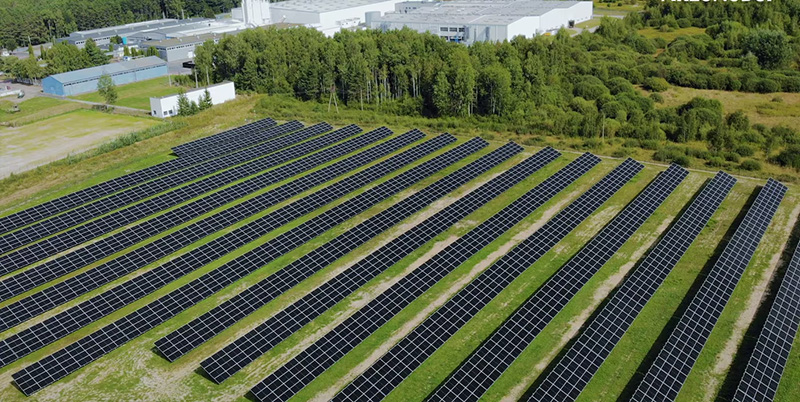
Solar panels at AkzoNobel’s site in Pilawa, Poland
One of the larger contributors was the company’s site in Pilawa, Poland, where a €1.7 million ($1.9 million) investment replaced the facility’s gas boilers with heat pumps. The site also houses AkzoNobel’s largest solar plant in Europe, operational since 2024 and built with 3,551 solar panels.
The harder work lies ahead in Scope 3 — the emissions generated across a company’s supply chain and through the use of its products — which typically dwarfs a manufacturer’s direct operational footprint.
“We also have a 2030 ambition to halve carbon emissions across our full value chain,” Bruinsma said. “That’s proving to be more of a challenge, but we’re making progress and will continue to innovate with suppliers, customers and other partners as we step up our efforts around Scope 3.”
That value-chain work has been building for years. In 2022, AkzoNobel organized supplier, customer and academic partners into project teams charged with cutting carbon across the paints and coatings value chain through circular-economy and solvent-reduction efforts.
A more recent example on the customer side is the Eco+ Cure energy calculator from AkzoNobel’s Interpon powder coatings brand, which analyzes operational data such as gas usage, oven temperature and throughput to help customers lower energy consumption, operating costs and carbon emissions.
The emissions milestone comes as AkzoNobel prepares to combine with Axalta Coating Systems in a roughly $25 billion all-stock merger that would create the second-largest coatings company in the world and bring together two of the largest suppliers to the collision repair industry. The companies expect the deal to close in late 2026 or early 2027, subject to shareholder and regulatory approvals.